
I GUESS MAYBE IT WASN’T THAT BAD….
l will walk you through the 14-plus years of my formal education, beginning with simple-at-hime skills I learned with the help of others, like tying my shoes and brushing my teeth. Then, I move into my half-day kindergarten; travel through the rigors of my Catholic school upbringing for nine years at the hands of the priests and nuns (and a few “lay” teachers}; then three years of high school; and finally attending post high school education at a technical school chasing a possible life career. Hopefully you’ll love it as much as I have enjoyed writing it over the last several years.
KINDERGARTEN – Washington School
I was 5 years and 141 days old when I first walked through the heavy doors of Washington Elementary School as a kindergarten student. The school was only three city blocks from the front door of the house I lived in with my folks and two younger siblings, the newest having been delivered only 24 days earlier. I attended the morning classes of Mrs. Larson. I walked to and from school each day with my neighbor Kathy who lived two houses away from me. Kathy was in the morning class of Miss Meyer. The whole idea of going to school was completely new, because there was no such thing as pre-school or “early” kindergarten as there is today. I liked the idea of making new friends, and found that many of them lived within a couple blocks of my home so I was able to expand my world as I knew it. I would end up going to school with many of them until I graduated from high school many years later, and remain friends with several of them yet today.
Times have changed with the world now being more mobile; both parents working, and families with more than one vehicle. Very few students got a ride to school in 1959. We missed the generational bragging rights of our parents who would claim they “walked bare-foot five miles uphill both ways, against the wind, the snow, and the rain…” (Like that ever really happened). But we did walk to school. If you can recall the imagination of a 5-year-old, those walks with my partner were really something. And so many years later, I can recall several of them. The first that comes to mind was a day that it had snowed, and it was very noticeable that these weren’t ordinary snowflakes. They were like little crystals, and the two of us referred to them as “diamonds”. There were so many that we made them into little piles of “diamonds”. And the plan was to bring a box or something the next day to pick them up and take them home to our mothers. I can distinctly recall our disappointment the next day when we stopped to check our fortunes, and they were gone! It was warm enough later the day before that they had melted. We could have been rich!! And of course, we didn’t have anything to show our mothers when we got home, and probably explained it by saying someone stole them.
Another incident that keeps coming to mind about the walks home from school was the day – I have to think it was purely an accident – but I lost a tooth, and it was all Kathy’s fault. I can’t imagine it had anything related to violence. I don’t think she slugged me, because I never knew her to have a mean bone in her body. And I don’t remember it being painful. Like any “baby” tooth, they were pretty much ready to come out on their own, anyhow. But the fact was, I lost a tooth. We couldn’t find it! And in those days, the Tooth Fairy paid 10-cents for a tooth, and I had nothing to put under my pillow. No shiny mercury dime for this tooth. As mothers do so well, we solved the problem by writing a note explaining the problem, and the dime was there when I looked under the pillow the next morning.
I excelled in recess, which would carry over for many more years as I ascended from one grade to another. It was the first I can recall how easy it was to be a “clock watcher”. Not just looking at the clock to see what time it was, but noticing when it was close to the time for recess, and watching the second hand go around three or four times until finally, the bell rang and we could go out to the playground. Good thing there was no clock outside, because I sure didn’t want to waste that valuable free time by waiting for it to end. This school was only three years old when I attended, and had two distinct playgrounds. Kindergarten was smaller and separate from the other where the “big” kids hung out. I had been to both before I ever started school because they were so close to home and my aunt Judy had accompanied me there several times.
I also enjoyed nap time (or break time for our teacher). We each had a small mat that we could lay out on the floor and relax in silence for a few minutes. My rug was woven from colorful strands of material and was just big enough for a five-year old to fit comfortably on, and was certainly much better than lying on a cold asbestos tile floor. I took my rug to the farthest corner of the room, behind the small tables and chairs and settled in to let my imagination run wild. When we were done, I would roll the mat up and stuff into the space in my locker outside the classroom to use another day.
All through my school years, right on through graduation 12 years later, our classes had more kids per room than the schools had experienced previously. That always caused some logistic and other problems. But the teachers were always able to maintain order. Whether it was in the classroom or the playground; or using the bathroom; or walking to the gymnasium for an assembly. The classroom was quiet and orderly, and the teacher was certainly in charge. The bathroom was so small, only one child at a time could go. Any time we needed to walk to a different part of the building, we walked in silence in a single line with our hands at our sides. We always walked on the right side of the hallway, following a particular line of colored tiles on the floor. Much of this would remain the same through my next eight years (in Catholic school), except the School Sisters of Notre Dame added a new appreciation of discipline.
We celebrated traditional holidays such as Halloween and Christmas and Easter (and we didn’t turn out too bad). As a gift to our parents, Mrs. Larson set us on a chair in the dark closet with the light from a projector creating a silhouette of our head from the side, which she traced, cutout and mounted on a white piece of paper suitable for framing. It made it home safely. It was a thrill to present it to my folks. Kindergarten was the first I heard of Abraham Lincoln. George Washington chopped down a cherry tree and could not tell a lie. We drew pictures on paper that was twice the size of normal size paper; with crayons as big around as a hot dog (I still have some of the drawings). We learned about policemen and safety; and firemen and fire prevention. And it was the first I can remember printing my name so others could actually read it.
When the year came to an end, we were all promoted to the first grade. Many would continue in the same building; others of us would move to Our Lady of Peace Catholic School six blocks to the west. Another of my neighborhood friends, Paul, was one year ahead of me in school. And unlike today, we were able to walk the five blocks to OLP the summer a week before school started and we walked through the building. It was a personalized guided tour by someone who had already spent a year there. I learned some new words as he pointed out where the “lavatory” was; and where the “cafeteria” was. It was a whole new world, and would be the center of my life for the next eight years.
__________________________________________________________
FIRST GRADE – OUR LADY OF PEACE CATHOLIC SCHOOL
No cause for alarm. In fact, I was quite excited to step in to my newest classroom and look on each desk until I recognized my name printed on a nametag and taped to the upper surface of my desk. This is the place! I quietly slid into the seat of that big desk with the flip top, when a voice behind me said, “when you get into your seat, you only get in from THIS (left) side!” I looked at the dark brown eyes as she scolded me. This was the closest I had ever been to a nun! Dressed in black with starched white highlights materiel as part of the large veil on her head. The eyes were dominant, mostly because her mouth and nose were the only other things visible.
OK. I thought to myself, “who are you?” What a thrill. This was the moment I first met Sister Mariam Frances, my new teacher. It is forever etched in my mind.
Once we had all the introductions out of the way, I lifted the top of the desk to see what surprises were in there. That’s when the little voice behind me returned with, “DO NOT open your desk until I tell you to!” OK, Sister. Fine. I’m thinking, the other kids are doing it, but you didn’t say anything to them. Why are you standing behind me, when there are 52 other kids in the room? The rest of the first day of school went downhill from there. It was the beginning of a very long year under the heavy hand of Sister Mariam Frances.
All in that very first day of Grade 1, we were (ALL) instructed to enter and leave our desk only from the left side. We were instructed to stand when we were called on, and only speak when asked to. If we had a question, we needed to raise our arm STRAIGHT into the air (and not wave our hand) and wait to be called on. We would go to the “lavatory” once in the morning; once before lunch; once after lunch; and once in the afternoon. The bathrooms for the boys were on the opposite end of the hall from the girls, and the one teacher could only monitor one group at a time. Girls first, then the boys. The wrath of the devil upon you if Sister would come back to the room with the girls and any of the boys were misbehaving (talking, laughing – anything but having your nose in a book). Sister must have learned from our kindergarten teacher Mrs. Larson, because the rules for walking in the hall were the same. As we filed out into the hallway to go to the “lavatory”, or restroom, we lined along a particular line of asbestos floor tiles, stood silently with our hands at our side, and were allowed to enter six at a time. No talking inside the bathroom as well.
Lunch in the “cafeteria”, or lunchroom, was much the same, except boys and girls line up in total silence in the hallway at the top of the steps until the group was completely assembled, and then preceded silently down the steps towards the lunchroom. Lunch was served by a group of gray-haired ladies who would scoop the sticky thick mashed potatoes and glob some greasy gravy over them; grab a boney looking piece of chicken (actually bones with only skin on them) and place them on the plate; and a spoonful of stringy, soft green beans to finish this meal fit for a king. Each class would proceed to a particular table to devour this concoction and others, and we were finally allowed to speak again for the first time since morning recess. Quietly! If the noise got out of hand, look out. That voice would sneak up behind you and let you know about it! When lunch and desert – a piece of cake or a raisin/oatmeal cookie or a bowl of canned cherries – we done, we deposited our garbage in the large plastic container; put our dishes on the large cart with wheels on it made just for dirty dishes; and went out the door for noon recess. Quietly! Do NOT, under any circumstances, throw ANY food in the garbage. You EAT it! A member of the school safety patrol was assigned to monitor the garbage can each day, and if something got their attention (like a loud CLUNK), and further investigation revealed leftovers, the culprit would be invited to once again enter the line and eat a second meal. For most, they only had to see it happen to someone else; and even those too dumb to get a hint, it never happened twice.
There were a number of “counts” taken each day. Sister would go through her book and read off each name for attendance. She could have easily looked for an empty desk and note that person absent. But perhaps it was her way to associate a name with a face. And it worked for us as well, because there were people in that classroom that we had not met yet in kindergarten because they were in another class or attending in the afternoon after we had gone home. Another number that had to be determined right away was the number of white and chocolate milk that were needed for our morning milk break. The milk came in small “Clover Cream Dairy” (the local dairy) glass bottles with a foil cover that could be peeled back to insert a straw and devour the contents. We received the same serving of milk with our lunch. (Thank goodness, in answer to our prayers, someone invented the durable paper milk carton, which if opened properly could conceal any portion of the meal not fit to consume and be closed to hide the evidence from the safety patrol. The trick was so set it into the garbage container so not to raise suspicion). Finally, an early lunch count was taken to prepare the cooks as they assembled the daily feast.
Being a Catholic school, the entire school attended church each day at 11:15 AM. As with any other trip through the hallways, everything was done in total silence, in nice neat rows, hands to the sides. We didn’t receive our first communion until second grade, so we knelt quietly as every other class filed to the front of church, knelt on the kneelers and received communion (that’s ten minutes of my life each day that I will never get back). Church was planned to assure those taking communion had gone the 3 hours required by church law with nothing to eat or drink before. Lunch period started as soon as church let out, as each class went in order to the cafeteria., followed by a very gregarious noon recess on the playground.
This gets me back to my favorite time of day, recess. The younger grades went out in the morning; at noon; and again in mid- afternoon. Boys and girls would romp and stomp on separate parts of the school yard. The girls would roam the front of the building. The boys were restricted to the back of school. I don’t rightly know what the girls did during their free time. But the boys would usually hang out by class; usually in the same area each day. Depending on the season, there would be a touch football game. “No rough stuff!” Basketball or baseball games; Kick ball; Pomp, Pomp, Pull away; Marbles with “cat eyes, crockies, or steelies”; swinging to the limits of the chains on the swing set; or just plain walking around. Everything took place under the watchful eye of the school safety patrol and any of a number of the School Sisters of Notre Dame nuns gliding back and forth with their arms folded and tucked up the opposite sleeve (that’s where they stuffed their handkerchiefs, too). Getting in trouble on the playground usually meant a trip to the principal’s office and no one wanted to go there, but it was quite common. But for the most part, it was some free time that was badly needed to escape the rigors and the regiment of daily school life.
At times, certain nuns were known to join us in some of the fun. Their habits, or their starched attire left little comfort for a nun to do anything other than walk in a straight line. The huge veil they wore on their head obstructed their view from one side to the other. You would think this would be an advantage to a mischievous student, but in never failed to make one wonder if they actually had eyes in the back of their head. Like God, they could see and hear everything! In later years as they changed and modernized the design of their habits, you still had to wonder if they had hair under that veil because even with the new design in the mid-Sixties, their hair was still covered, but it was no longer so stiff and bulky and their peripheral vision was no longer compromised. But you still had to wonder if they had hair on their head.
Sister Ann Raymond liked to join the fun. She would get in line to try to hold back the opponent in a game of “Pomp”. And she could kick a red kickball higher and farther than any of the guys in our class. The good thing about her playing with us was we could get the ball back if the ball accidently ended up on the roof of the convent – or nuns house – which happened from time to time.
The reason we were in school was to learn to read, write, add and subtract. We did this much through repetition. If we were learning a word, we would repeat the letters over and over again. C-A-T; C-A-T; C-A-T. If we were asked to spell a word once we had learned it, we would be recognized, then stand to the left of our desk, and spell it for everyone: “C-A-T…Cat” If we were learning to print letters, regular and cursive, Sister would have an example of the letter or number, which she would pass to each of us. She would also point to the letter which was clearly visible on a collection of green cards taped across the top of the blackboard at the front of the room, sometimes tracing it to show how it was formed. Then we would spend time at our desk and at the chalkboard tracing the actual letter over and over again until it was nearly illegible. I always thought the finished product of tracing it made it look like a bundle of strings of spaghetti. Once, we were asked to write each letter we had learned on a piece of paper as a test. Some were easy to recollect, but not wanting to miss any, I went back over them by looking at those green cards on the blackboard. Well, when we were done, Sister asked me if we had actually learned to print a particular letter. I said yes. She said no! She asked why I would include that one in my list. I said it was clear looking at it on the board that she had traced it with chalk in her hand once, because the chalk line was still visible. WRONG answer! I paid dearly for that one.
________________________________________
SECOND GRADE – OUR LADY OF PEACE CATHOLIC SCHOOL
I enjoyed the summer after first grade, and especially enjoyed spending time at Hefko swimming pool. Some days I was at the pool twice, taking swimming lessons in the morning with my cousin Cheri first thing in the morning when the air and the water were ice cold. Cold made no difference, the lessons were held anyhow. Despite the cold, we needed to submerge our entire body while grasping the side of the pool with our arms extended, kicking our feet to stay afloat and mimicking actually swimming. I did this for three consecutive summers and am very glad I did. I would hate to have a fear of swimming, and I have memories of many good times in the water through the years.
I would also hang out with my neighborhood friends Paul, Allan, Gary, Rick, and Jeff and even a couple of our younger brothers. There were baseball or football games in one yard or another. Picking teams for baseball involved pointing to each person available to be picked, and saying “One potato (then point to the next person and say) two potato (and then the next) three potato-four…..until someone was selected – and then do it all over again until each team was filled. Another was (one person at a time) “my-mother-said-to-choose-the-very –best-one- o-u-t-spells-out-and-out-you-will-go…..But first there was the process of which captain got to go first. That involved flipping a baseball bat for someone to catch, and each captain grabbing the bat above the hand that caught it – one captain at a time until one hand reached the top, and that person could pick first. All very democratic. Once we had the teams, we played until someone got hurt and went home crying; or someone got mad about something and it was obvious there was no chance to resume the game.
When we played football, the age difference and the size advantage we older guys had meant the younger kids were always on offense and we lined up on the line of scrimmage, and we gave them every chance to see how many touchdowns they could make. However, we were relegated to doing everything from on our knees, lined on the front line to at least give “them” a chance. It worked well when they ran the ball, but once they started passing and actually catching the ball, it no longer seemed fair.
It was about this time in my life that I realized there were other groups of kids our age living a bit beyond our own neighborhood, because sometimes the two groups would end up at the same place at the same time. One example –at “first tracks”. The Soo Line Railroad had a single rail that ran from Marshfield to Greenwood, about 25 miles to the west. It was called first tracks because it was the first of two sets of railroad tracks, and they were only a few hundred feet apart, both going in different directions. Of course the other tracks were known as “second tracks”. Second tracks had two sets of rails, and both first and second tracks all came together at a junction just to the east of where we hung out. A bit of a rivalry developed as each group began to create forts in the slopes along the track, using downed brush and branches for cover. One and sometimes two trains a day would travel on first tracks, and we once we figured the schedule, we often times spied on the train from our forts as it went by slowly, crushing the golf ball size stones we put on the track with the massive steel wheels, or once in a while a penny or a nickel were flattened as thin as a steel of paper by the monster train engine. Trains on second tracks were much more frequent (50 per day) and traveled rather fast. We would sometimes venture over there but only watched from the high ridge along the track, and I don’t recall ever placing anything on those tracks.
The only good thing I can remember about my year in first grade was passing, and moving on in positive anticipation of shaking Sister Mariam Frances, and enjoying a new year, with a new teacher and moving into a new classroom. All summer I imagined what it would be like to actually enjoy school, because that first year was hardly anything I care to remember. Sister Mariam Frances wanted my folks and I meet with her at the convent in the evening from time to time so she could try to impress upon them, and myself, that I “had the ability but simply didn’t work up to my potential. He daydreams all day, and has a very difficult time staying on task!” Today, that type of behavior is diagnosed as A.D.D. and now days they give a kid a pill for it, and accept it.
I mentioned the class I was a member of – all through school – was always the largest class to attend any of the schools up to that time. Several adjustments had to be made to accommodate us. Rather than just one classroom per grade, our class always needed to be split in two classrooms. For second grade, we required one large classroom with 50 or so students, and the other split with another grade, most times the older kids in the grade ahead of us. The first day of school is always exciting. Before that day came, my mother would receive a package from J.C. Penney Co. with new pants and shirts to fit me, and we would visit salesman Randy at the Penney store shoe department to fit into a new pair of dress shoes. But I especially anticipated a new teacher.
It was fun to join all by former classmates in our “old” first grade classroom when we returned for the new school year. What classroom would we move to? Who would be in our new class? Who would be our new teacher? As we all sat quietly in our old desks, the second grade teacher, Mrs. Meyer came in and greeted us. She smiled as she read off each name, and the student would rise from the desk and form a line in the front of the room. My cousin Cheri had Mrs. Meyer the previous year, and though she could be quite vocal at times (you could hear her shouting in the next room), I was convinced she would be an OK teacher to have. But when she reached the end of her list and I wasn’t one of the 20 students standing in the front of the room to follow her to her classroom, I and the remaining others like me sat there in anticipation of who we might get.
Suddenly, Sister Mariam Frances walked in the door! We all said in unison (as we were taught), “Good morning Sister Mariam Frances!” She didn’t even smile. She said, “those of you remaining in your seats quietly form a line across the front of the room and I will take you to your new classroom”. We did as we were told, walked out the door and into the next room off the hallway (which was Mrs. Meyer’s classroom the year before. Sister directed us to, “find the desk with your name tag taped to the upper part of the desk and sit down.” Déjà vu – same instructions we had the previous year! As I sat there, I started to take a look at things around the room, and I became frightened by much of what I saw. It was all too familiar! It can’t be that every room has the same statue of the Blessed Virgin Mary situated in the same part of the room?!?! The same “Welcome” message as the year before pinned to the bulletin board across the front of the room above the blackboard? The same array of teaching tools on the teacher’s desk? NOOOOO! There can be no way we would get the same teacher as last year! She was a first grade teacher! But unfortunately all my fears were confirmed a minute later when Sister Mariam Frances sat down in the chair at the desk in the front of the room and announced, “You will all be quiet! And stand for our morning prayer”. OH, GOOD GOD!!! Another year! This can’t be happening to me! Someone made a mistake! NOOOOOO! It was that very second in my life that I lost all interest in school and that feeling carried through for all the years to come – with some exceptions. But I am convinced that once you lose that enthusiasm to be in school and to learn – only a miracle can bring it back. It was going to be a long year. I went home that night and cried. And cried.
Now, Sister was not a bad person! She certainly had her hands full trying to make us all learn things we would use through our life, especially the basics: reading, writing and arithmetic. And any teacher would need to dicipline us as we learned life’s graces, such as organization and respect. Much of the “respect” was learned at home from our parents. Respecting older people such as our friends parents meant we called them “Mr.” or “Mrs” – not Jerry or Rita. But Sister and our other teachers needed to maintain order in the classroom, the playground and the lunchroom. Not an easy task with 50+ kids packed into a classroom. All in all, Sister Mariam Frances ranks high in my overall list of respected teachers.
Imagine the thrill I (both of us) experienced 55-years later when I vistited with her, spending the day with her in her apartment after she had retired, recalling the times, the places and the people we shared in our memories from so many years before.
A couple major events in my life occurred while in second grade. I received two of the seven religious sacraments recognized by the Catholic Church and by doing so, I moved up the ladder of being a Catholic. I received the first when I was born and baptized by Fr. Walter J. Dillenburg. It was felt at our age (8 years old) that we were old enough to recognize our sins and to ask forgiveness and it was called penance, or confession. One had to be forgiven before they could receive the Eucharist, or Holy Communion. The preparation to receive these was rigorous, and was in addition to learning to read and write and arithmetic (or spell it using the first letter of each word in this phrase: a rat in the house may eat the ice cream). All the learning culminated with our class walking into church as a group, kneeling in silence to await our turn to go into the confessional, a small closet in the rear portion of the church with a door to enter and something for then penitent to kneel on inside. The other closet door was where the priest sat, and he would slide a window open to hear what you had to confess through a curtain dividing the two of you (to protect your identity); and then give you some prayers to recite; and finally give a blessing and have you go on your way, comfortable in knowing all the nasty stuff you did was forgiven.
First Holy Communion took place several weeks later, and was a full-blown ceremony in itself in front of the entire congregation at one of the four Sunday mass services. We gathered in our classroom, the boys dressed in black pants, white shirts and ties (mine was a clip-on bow tie) and black shoes. Girls wore a white dress and white shoes and a white veil on their head. All Catholic women had to wear some type of covering on their head prior to the Second Vatican Council (1962-1964), when many of the traditional Catholic traditions changed. Up to that time, everything in the mass service but the reading of Epistle and Gospel, and the sermon by the priest – was performed in Latin. To receive communion, one had to “fast” from the evening before going to church, but especially for three hours prior to communion.
As the ceremony was about to begin, we filed in silence in the hallway just outside the doors into church, and as ordered by Sister Mariam Francis, “fold your hands with all your fingers sticking straight up in the air towards the ceiling, close to your body and in front of you.” The doors opened, and we filed down the center aisle of the church with our parents on either side of us. Once we reached our assigned pew, we filed in and stood in silence until each student was present, and as a group, sat down. It was a big thing at the time. It was something the big people did and now we were part of it. It gave a whole new meaning to going to church, rather than just sitting there and taking it all in. We were big, now.
Getting back to school, learning school subjects was again a challenge in second grade. And that would seem to be the case from this point forward until I graduated from high school. My report cards will reflect that. I just had a tough time keeping my eye on the prize – a good report card. One of the only things I ever did well was taking the Sanford timed tests each year to gauge our learning. And to tell the truth, there was no way I could ever finish one of those tests unless I cheated. I got bored after the third question, and in looking around, some kids were on the second row of filling in the little circles with their No. 2 lead pencils. And I was still on the first problem. When I said cheated, I don’t mean looking at someone else’s paper. I cheated by merely filling in the little circles in a pattern that looked good. One here, one there, back over there, the next two the same. And on….. And you know what? I surprised myself, and my teacher, and my folks and did quite well. But even that came back to bite me. When compared to my abilities according to the ability test, my daily school results were a complete contrast. Thus, the teachers concluded that this young lad “was not working up to his ability”.
After only two years of school, I felt worthless. I saw absolutely no need to try anything because I would be proven wrong. I did not raise my hand to answer questions, because I would be wrong. I didn’t like tests, because it would come back with big red circles and streaks on it and most everything marked wrong. When I reflect to when I first started to hate school, it’s very easy to point to first and second grade.
But, there were positive distractions taking place throughout the year. My neighbor friend Paul, who was one year older than me, had joined Cub Scouts the year before, and his dad was one of the scout leaders. Cub Scouts wear a dark blue uniform with colorful patches all over it, and sometimes they wore those uniforms to school. I was able to join and started to work my way up through the ranks in the order everyone else had, starting with Bobcat, and was proud to pin the bronze Bobcat pin on my uniform. We were Pack 80. The older boys were Boy Scouts, and they were in Troop 80. The number changed through the years, first to 280, and later to 680. When I started, the program was very strong with as many as 50 boys from first through fifth grade, and those numbers continued for the first few years I was in Boy Scouts. The other ranks I passed through were Wolf, Bear and Lion. It took most of a year to reach each level, and if a scout worked real hard, they could earn gold and silver arrow points which could be sewn on the uniform. There were skills and various project and programs needed to pass each level, and much of it could be attained during our weekly “Den” meetings. The awards were passed out during the monthly “Pack” meetings, in front of the other 40 kids in the pack and their parents who attended. The Pack meetings also included themed skits put on by one Den or another, and were always a good time, including treats and surprises. The last level of Cub Scouts was passing the requirements to the entry level for Boy Scouts, or obtaining the “Tenderfoot” badge which I earned in fifth grade.
And there was always recess! I am convinced that school for me was a social event. It was an opportunity for me to get together with my friends each day. Sister Mariam Frances didn’t see it that way. She pressed, and prodded and tried to light a fire under me. My folks continued with meeting several evenings throughout the year on Sister’s home turf, the convent. I know I wasn’t the only one who received this special treatment. There were several others in our class who were struggling for much the same reason. It wasn’t defiance. I liked to learn new things, and I did grasp things when I was interested. But I was so easily distracted. I found out at the end of the school year what happens to students who just can’t cut it. They get held back a year!!! They have to go through the same grade all over again. PLEASE don’t do that to me! I’ll buckle down! I’ll learn! I’ll pay attention! But I can’t do this all over again”. Some kids did. But only a few, and I wasn’t one of them. But that threat remained, and rose it’s ugly head a few times as I advanced through the grades. But as far as second grade, I received my final report card on the last day of school, and I was moving on to third grade. The only thing that remained to be seen was if Sister Mariam Frances might again be waiting for us when the new school year started after three months of summer fun.
_______________________________
THIRD GRADE – OUR LADY OF PEACE CATHOLIC SCHOOL
The summer was fun. As expected, my friends and I spent much of the summer at the swimming pool. Baseball made up a large part of our summer. I had started to play Peewee baseball. Peewee meant playing against some kids who were a year older and standing in the batter box against someone who was rifling the ball past you faster than I have ever seen before. After watching one or two players go down to the dirt in pain after being beaned by a wild pitch, it took some courage to stand in there against some of the more wild pitchers. I also found that getting hit in the left elbow by a speeding pitch gone wild – well, there was nothing funny about the “funny bone”. But in the end we got it done, and enjoyed being part of a team. And it seemed I played catcher most of the time – or center field.
Organized ball was much different from playing with just the kids in the neighborhood. We had tried to make things easier and more competitive for the younger kids in our neighborhood games, and started using whiffle balls, the plastic balls with holes in them, and hit them with a plastic bat. The ball would still fly if you got a good swing at it, but not near as far as a regular ball that could travel two or three neighbor yards away. I lost count of the number of windows in the neighborhood we popped out using a real baseball. And heaven forbid we ever hit a ball into Old lady Nest’s garden adjacent to one of our ball “diamonds”. Might as well kiss it goodbye, never to get it back. Old lady sat in a chair in her back yard just waiting for us to hit one in there. We were never sure, but we think she had a gun across her lap, waiting to put us in her sights if we risked a baseball rescue mission. Only to find out years latter that it was in fact a wooden cane she used to walk back and forth to her house.
A number of Columbus high school boys had organized a group of kids from our grade school into a small league and we played our games in the evening in an empty field a block from our school. Some of those older fellas were star athletes all through high school, and included brothers Chuck and Bobby Koch and others. And during the summer months, these same star athletes also played American Legion baseball which gave several of us a reason to go to some of their games to watch them play. The American Legion played some nights and some weekends. Another group, the Cloverland League played when the Legion wasn’t playing. I only lived 4 blocks from the ballpark, so it was nothing to find me there for most of the games. I think it’s only natural to for younger fellas like us to look up to these guys, so you can imagine what a thrill it was to be part of the program they started for us (we even got t-shirts with our team names emblazoned on them – mine was the “RAIDERS”). And they helped form a better understanding of the game and some of the basic techniques. It’s the first I recognized where right and left field were in the outfield, because when we weren’t batting, I waited out in right field for a fly ball to come sailing my way. When batting, the pitchers seemed more controlled – at least I don’t remember getting beaned.
Columbus High school had some fantastic athletes besides the Koch brothers. And I listened to most all of their basketball games on the huge tube radio in my bedroom on Tuesday and Saturday nights. Contrary to instantaneous reception as we know it today, I needed to turn on the radio and wait for the tubes to warm up before any sound came out of the speakers. I would close by bedroom door and sit there munching on my favorite Pleez-ing brand potato chips. Jack Hackman always did the play-by-play report of the action on WDLB-AM radio, and he sometimes got as excited as the crowds with the Columbus Dons winning play. There were even times that my dad and I would take in a game at the Columbus gymnasium. During football season I would also listen to the radio to any football games that we didn’t actually attend in person. I distinctly remember parking out on E 4th St and walking two blocks to the stadium, and the excitement of seeing all those big guys in their blue and white uniforms up close. Those were our hero’s out there playing and I don’t remember them losing very often.
There were things kids our age could do at baseball games when the big guys played. Most kids chose to wait in the shadows and chase foul baseballs that were hit outside the field of play. Some went in the bushes, some went in the street. But the bounty for returning a ball was usually a ticket worth ten-cents in trade at the snack bar. A dime would buy either two candy bars, or a soda, or a bag of Old Dutch Chips or popcorn. If we got to the park early enough, we could get chosen to be batboy and shag out onto the field to retrieve bats once a player hit the ball and ended up on base. This also meant a treat at the end of the game, chips, soda and candy. And if Mickey Vandehey cracked a bat hitting one of his many homeruns, the batboy might get to take the bat home (but it was so big it almost took two guys to carry it). One of the jobs that was as much fun as being batboy was working on the scoreboard in center field. As many as three kids could team up and hang metal sheets with numbers on them on hooks, each time the teams changed fields. The numbers showed how many runs were scored by each team. The downside of that duty was the mosquitos in the evening, or the pounding sun on a hot summer afternoon with a temperature of 90 degrees. Once you were out there, you were there for the whole game. But the reward for your efforts was a ticket for 25-cents, and that meant a candy bar, a soda and a bag of chips!
Rather than getting packages delivered with new school clothes from J.C. Penney Co. as we had in the past, my mother and I instead went to the store and tried some new clothes on. That meant taking a handful of shirts and pants into a very small cubical with just enough room to stand up straight in it and a small chair to sit on while changing. There were pins and pins and pins that first had to be removed from each shirt or pair of pants. And paper and cardboard that had been used to make the clothes look so nice. I did not like it! I still do not like trying clothes on in a store! This was not my idea of a good time, because it was hot and stuffy and when the clothes did not fit, I received another load to take in there to try on. But, we got it done and I was going home with new clothes. But before we left, we had to stop and see Randy in the shoe department for some new shoes and always, he served us with a smile and always said, “Well, hello Mrs. Meyers!”. That meant more as years went by and mother would bring my three younger brothers in for new shoes to begin the school year with. Then, there were dollar signs in Randy’s eyes when we first appeared. And it wasn’t a tough task for him. All four pair were the same style, just different sizes. Whiz-bang!
The closer it got to school starting again, the more I started to fret over who my new teacher would be. That took away from would have been the normal excitement of moving into a new classroom. If everything went the way it should, we would have a new teacher, and the classroom would be the next down the hallway – one of the few rooms with only one door. I don’t know why that was such a big thing, but sometimes it’s the little things that are pleasing. My neighbor buddy Paul and I even walked to school a week early while the teachers were preparing their rooms for the new school year. We took a chance by asking the principal, Sister Christa Marie, who our new teacher might be. Big secret! She wasn’t going to give in, regardless of how many times we asked or how pleasant we could be. We would just have to wait for the first day of school like everyone else.
I walked to school with Kathy for the first day of third grade and took a seat in my old second grade classroom. Looking around the room, I felt my greatest fears were about to come true. The room we called home the previous school year had no evidence that Sister Mariam Frances was going to be in that room again for the new year. No familiar statue of the Blessed Virgin Mary. No familiar “Welcome” message tacked to the front bulletin board. Of course, I thought the worse. Was she moving on to third grade with us? OH NO! No! No! But a moment later, portly little Sister Viventia walked into the door, swaying from one side to the other like she did, and started to read off names from the list in her hand. What a relief when she finally called my name and I joined the line in the front of the room. Those she had read off eventually followed her to the next room – the classroom with only one door! Now, I thought, this could be fun! We had left some behind but as usual; they would be scooped up by another teacher and be part of another split-class with either the second or fourth grades. I wondered if any of them would get Sister Mariam Frances again, or if she was going back to teaching first grade. I guess it didn’t really matter.
Most of the teachers in our school were nuns, the School Sisters of Notre Dame, or SSND. They were commonly found at Catholic Schools especially throughout Wisconsin as well as elsewhere in the United States. They also taught in missions throughout the world, more specifically in several locations throughout Africa. Nuns from our school and Columbus High School lived in the convent situated between the two schools. The other Catholic schools in our immediate surrrounding area also included SSND nuns.
When I first recall seeing a nun, it brought several questions to my mind. They were literally black and white. The only flesh visible was their hands, and a very small percentage of their faces – only their eyes, nose, mouth and chin. They wore a completely black habit with a bib and the inside of the veil made of starched white material. Did they have a neck? Did they wear that outfit when they slept? One had to wonder if they had hair? The veil concealed most of their face from the side, which one would think would be an advantage to a mischievous student. If you are normal, you have 120 degrees of peripheral vision – from one side to the other without moving your head. Could the nun see from side to side? It didn’t take long to realize the nuns suffered no real disadvantage. In fact, more than one student witnessed instances where they were assure a nun could see quite well to either side, and more important, the nun likely had eyes in the back of her head! They could see everything! And with all that clothing, you also had to wonder if they even had ears? Eventually, one would be convinced they did, and their hearing was not affected being hidden behind all that material. They could hear a pin drop!
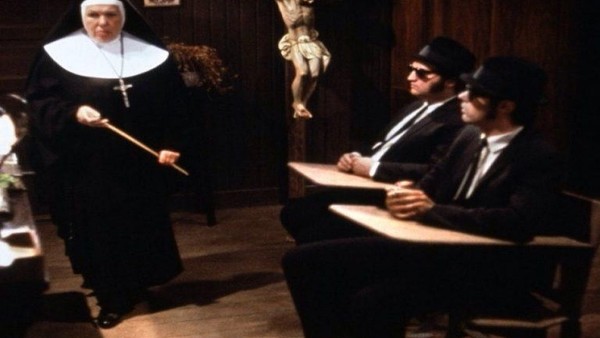
Nuns in general have been depicted in several movies. There was the movie, “The Singing Nun”. Another that comes to mind is “The Blues Brothers”, where Jake and Elwood Blues visit Sister Mary Stigmata at their old school and orphanage, and she glides across the floor like she’s on a cloud – rather than walking.
I’m not so sure they had pockets anywhere on their garb. Their sleeves were very versatile. They could cross their arms in front of them, and stick each arm into the arm of the opposite sleeve. I suppose if they had to carry a pencil on their person, they probably stuck it up one of their sleeves. It would be a convenient place to hide a cookie or two if they were to take them from the lunchroom for a snack later. And it is no secret that they stored their handkerchief there. It was always one of those many mysteries about nuns.
Modernization came to their rescue in 1963. The new, modern design of the “V” habit allowed them much more freedom of movement. There was more white in the design, and gone was the stiff, starched bib and veil, replaced with one that was much less complicated and even fashionable. Now, it seemed more of their face was visible.
Up to this point, any penmanship (writing) was done with a thick black lead pencil. And each student was required to have a large red eraser to correct mistakes. Not so much in the beginning, where my writing was nothing to brag about. Fortunately, later report cards showed that I was capable of getting an “A” – at least in penmanship – where I excelled!!
Eventually, we graduated to mechanical pencils with thick lead in them. That ended up being a distraction, and I found myself tinkering with the pencil trying to feed a new piece of lead into it rather than the assignment I should have been working on. And they wondered why I couldn’t get my work done.
Grade Three was a transitional year and we were now able to use Glow-O pencils, available with the outside painted in any of several bright colors: green, red, gold – and smaller traditional black No. 2 lead. Now, I don’t know much about things like this, but I can think of a better place to locate a pencil sharpener in a classroom than in the back of the room between two large windows. With the exception of one school year (see Grade Six), my desk was usually near or in the very front of the room within arm’s length of the teacher. So it would be a pretty good hike for me to go from my desk, down between two rows of desks with about ten fellow students in each row, and finally to the pencil sharpener. This took place sometimes several times a day! And they wondered why I couldn’t get my work done.
And eventually we were allowed to use an ink pen. The instrument of choice was the blue BIC Cristal (spelling is correct) pen – “as seen on television”. The popular television commercial showed an ice skater strapping a BIC pen to their skate, make a few laps of the ice rink doing all sorts of tricks, and sliding sideways to a stop with ice chips flying all around them – then unstrap the pen and write “BIC” on a piece of paper – and the announcer declaring, “Writes first time, every time! BIC!”. And they only cost 19 cents!
____________________________________________
FOURTH GRADE – OUR LADY OF PEACE – Teacher: MRS. SEE
Just prior to the summer between third and fourth grade, the young and vibrant President John F. Kennedy challenged people in the nation to take a 50-mile hike in an effort to make people health and fit. He used the idea to chide a member of his staff who was more portly and liked to smoke cigars, and felt if Pierre could do it, anyone could. Pierre didn’t bite and respectfully declined, making a big hit in the news. But the president’s brother was not afraid. Robert Kennedy, the Attorney General in the Kennedy White House cabinet, strapped on his leather oxfords of all things, and hit the road – and completed the task. My neighbor friend Paul and I set out on our own “hike”, with a bag lunch in hand (peanut butter sandwiches and something new for me – cinnamon gram crackers). We headed for places around the city we had never before explored. We would walk about four blocks, stand on a street corner for a minute, figuring we must have gone five miles! We went another five blocks, stopped and reflected on the area we had covered, and again figured it was worth about ten miles. Eventually, we ended up near the highest point in the city, our destination, the local cemetery. We had each been there before with our families, or marching in the Memorial Day parade with our fellow scouts. But the walk up there was something completely new. We marched from one headstone to the other, from his dead relatives to mine, and everything in between. When we were done and headed downhill back towards our home, and we figured we had covered the majority of the miles needed to call the hike a success. By time we reached our neighborhood, we could claim we did it! 50 miles! (in reality, we were lucky if we covered more than two miles!).
The first day of school was much less dramatic than years before. I couldn’t imagine any reason we might ever have the same teacher again, so the questions remained: what room will we be in, and who will our teacher be? As we returned to our previous classroom with one door and sat in our seats, Mrs. Schlagenhaft came in and read off twenty names and they followed her to the next room down the hall. Once again it appeared I would not be in a split room. Then, about twenty other kids came into the room followed by a new teacher, Mrs. See. We were going to remain in the classroom with one door. She placed each student in one desk or another, and when everyone had settled in, we got started for another year.
It seemed strange to have a teacher who was not a nun. There were four ladies who taught various classes in the building. For the most part, one of the nuns would come into our room to teach catechism (religion); and one in particular went from room to room teaching music to some classes. And as in the past, the entire school went to church each day.
And there had been no changes in the sad state of affairs in the lunch program. Some kids chose to carry lunch to school and be satisfied with peanut butter and jelly sandwiches. I continued to eat the hot lunch, which was a crapshoot as far as what you were going to get each day. I’m convinced Fr. Dillenburg, who was well known to be very thrifty, was getting the best deal on the food he was buying for the lunch program. I’m not exaggerating when I say the chicken was merely bones with skin on it. And you could stand a telephone pole up in the mashed potatoes. Maybe two of the five days in a week were eatable. The rest were stuffed into the wax milk carton and placed carefully in the basket with other refuse so not to attract the attention of the lunchroom monitors and have to go through the line again and actually have to eat it with someone watching.
There is nothing more boring than practicing making a cursive “S” on a sheet of lined paper 200 times as we did in earlier grades. Third grade was probably the first time in this school that I “wanted” to learn. It probably had much to do with more interesting subjects. That same urge carried through into 4th grade, likely because I felt comfortable with Mrs. See and did not feel threatened. Also, this would be the second year I did not have to join my parents for a regularly scheduled meeting with my teacher, which I never looked forward to.
I was expanding my circle of friends, slowly but surely. There was a fella named Joe, who could sometimes be described as a devil. Not THE devil, but if there was to be any trouble, Joe was surely to be near it or part of it. But friends are friends. We knew well enough that we could not shoot a BB gun within the city, so we rode our bikes out to the west city limit road, and stepped out into the “country” and proceeded to take shots at meadow larks and street signs, and porcelain insulators on power poles, and green glass insulators on telephone poles. It all seemed harmless. All of a sudden, we heard sirens. The sirens were coming from all directions around us. They squealed their shrieking warning for what seemed liked forever. We thought they were coming for us! So we quit our fun shooting spree, jumped on our bikes and headed down the hill back into town. Joe didn’t live far away, so we made our way to his house, put the gun in his garage, and hung out acting like we did nothing wrong. But, the sirens continued as we stood there, and for at least another five minutes. Maybe they weren’t after us! But what was going on?
We found out the next day that a house in the country had burned to the ground, and belonged to the family of our classmates, twins Bob and Dick (or Dick and Bob). It was hard to understand, because it was a brick house! Someone with more smarts than me explained that there is a lot of wood and insulation and furniture and other flammable things in a brick house, and they can burn to the ground just as easy as any other house.
I was still easily distracted from my daily studies by things happening around me, or outside our classroom window. The fact that it was written down somewhere in my record proved no surprise to my new teacher, who no doubt was warned that I was going to be difficult to keep motivated. And in reflection, Mrs. See did quite well.
Two major events in the world took place the year I was in 4th grade which proved to distract even the most disciplined person, both student and teacher alike. The first occurred on a dreary, rainy Friday afternoon in November. We had just come back into the building from noon recess and as we did each day, we were standing to the left of our desk reciting a prayer; then putting our hands over our hearts we recited the Pledge of Allegiance to the flag, “…one Nation under God…”. While we were doing that, there appeared to be some commotion in the hallway outside our room. Then suddenly, someone began pounding loudly on our door. We kept saying the words to the pledge, and the person kept pounding furiously. The student closest to the door is responsible for answering it, which she did, and by then, Mrs. See had started to make her way to the back of the room (in the room with only one door); and there she met Sister Ann Raymond and both went out into the hallway, closing the door behind them. It is often said that people remember exactly where they were when very significant events occur and this is one such case. When the door opened and Mrs. See re-entered the classroom, it was very easy to see that both she and Sister Ann Raymond had tears in their eyes. I never saw a nun cry before – or since! Was that possible? When Mrs. See reached the front of the room, she took the radio off the top of the piano, placed it on a chair near an electric outlet and plugged it in. An announcer was stating several details and then said President John F. Kennedy had been shot while riding in an open limousine in a parade in Dallas, Texas, and it was unknown at that point if he was still alive. A short time later, it was announced that he had died and we spent the remainder of the day listing to news reports until the bell rang marking the end of the school day.
I normally walked with my neighborhood friends both to and from school each day, but it was raining when we left on November 22, 1963, and some of those friends, Rick and Jeff and Kathy and Jean and I piled into their station wagon and Mrs. H. gave me a ride home. The television was on when I got home, and rather than the Three Stooges or Mickey Mouse Club, or American Bandstand, there was nothing on the tube but news about the Kennedy murder – for the next four days! Morning, noon and night, it was the only thing on any of the three channels on the television. It was a constant presentation of events, the facts and plenty of premature speculation.
It was dark already when my dad came home Friday evening, and my uncle Don came over and I was joined by everyone in our den in front of the television. About that time, the big, shiny jet landed in the dark in Washington, DC, and like everyone else in the world, we watched as everyone on the plane and the dead president’s casket departed the plane. Then, someone I never heard of before spoke to everyone watching, standing in front of dozens of microphones. The new president, Lyndon Baines Johnson was trying to assure the nation that everything was under control. Saturday included visits by dignitaries to the White House. Sunday morning, a slow motorcade made its way to the capitol building at the other end of Pennsylvania Avenue. The parade included a flag draped casket of President Kennedy strapped to a horse drawn caisson, pulled by a team of dark horses; a single rider less horse named “Blackjack” tugging restlessly at the reins held by a patient attendant; a line of black limousines carrying important people and Kennedy family members; with soldier honor guards marching to the beat of the dreadful funeral drums. This was followed on Monday by another motorcade back to the White House; then the Kennedy family, followed by leaders of nations around the world walking to St. Matthew’s Cathedral a few blocks away. Following the service in the church, the late presidents young son, John Jr. stood at attention and saluted the flag and the casket which made the strongest of men shed a tear; and finally the procession traveled across the Potomac River to Arlington National Cemetery for the burial with full military rights. The twenty-one gun salute made people uneasy remembering the shots fired only days before; and the massive, silver and blue Air Force 707 presidential jet flew low over the ceremony and tipped its wing in salute.
I was glued to the television the whole time, and was at Rick & Jeff’s house Sunday morning with the television in the background when the purported assassin of JFK was gunned down in the basement of the Dallas police station in front of the live television audience. I was only 9 years old, but I could sense the obvious sadness and the disbelief and the shock that the adults were experiencing.
After the declared national day of mourning on Monday, we returned to school on Tuesday and what we had just witnessed was the topic of discussion for most anyone for some time after that. It was like nothing we had ever experienced before in the school atmosphere.
A little more than two months later, the other major event which would eventually change the world occured on Sunday, February 9, 1964, again in front of a nationwide television audience. Four mop head lads from Liverpool, England invaded American soil by stepping on the stage of the Ed Sullivan Theater in New York City and singing three songs in their first set, and two more songs in the second half of the very popular hour-long Ed Sullivan variety show. The songs they were singing would each become a smash hit, and they would go on to sell millions of 45 RPM singles – vinyl records, and millions more 33 ½ RPM plastic long pllay albums with millions more to follow for the next 50 years.
Girls screamed and fainted at the sight of the Beatles: John Lennon, Paul McCartney, George Harrison and Ringo Starr. Their hair hung down over their ears, in contrast to the crew cuts or the greased back duck tail styles of those their same age in the United States. Beatle wigs, trading cards, dolls, posters, lunch boxes, pens and pencils…..anything you could imagine was emblazoned with images of the Beatles. They were a marketing marvel. Everything about them turned to gold. They made two movies, both featuring a collection of current hits and titled after one of them. A black and white hit called “A Hard Day’s Night” and a color film named “HELP”.
The British Invasion hit America with its harmonized vocals, its twangy and its deep bass guitars and it’s varying drum beats. At a time anything good in the world seemed hopeless following the murder of a vibrant, young world leader, this group and others to follow turned things around. There was more to life than Elvis. And I know there were “country music” records being made, but I was not exposed to anything like that, and have not developed a taste for it even today. With the “new” music, there was something to jump up and down and get excited about. But the adoration followed generational lines. Adults had nothing good to say about the hair style (which grew longer in years to follow). Most older people couldn’t stand the sound of the music and insisted it be turned down, or off completely. Interestingly, much of that same music eventually became acceptable as background music in elevators and dentist offices.
I couldn’t tell you much of what I learned in fourth grade, but it certainly was a year that separated a time in my life where I didn’t care much about what was happening around me and in the world – to the point I first recognized the need and desire to follow things in the news. And it was a distinct point that I developed a keen interest in a place known as Washington DC. I would have to wait over 40 years to travel there and see the many sights the historic city has to offer. I can still feel the sense of awe when I reached the northeast gate of the White House against a clear blue sky, with a blanket of fresh snow spread in front of it. The very moment I first saw the building shielded by the majestic trees along the circle drive – it physically took my breath away for the moment. This is it! This is really it!!! And the eternal flame on the JFK grave in Arlington Cemetery is touching in itself. (Many years later when I was Mayor of Marshfield, I did by weekly 10-minute radio show via cell phone from that very place). But nothing topped the thrill on a subsequent visit, of taking an evening trolly tour of the city – in the evening, and stopping for a moment as the tour guide directed us to watch the eternal flame flickering in the distance as we sat in front of the Lincoln Memorial a mile away!
And it took 46 years to visit Dallas, Texas and personally take in all the places associated with that fateful day, November 22, 1963. I could write a book about that experience all by itself.