
Voluntary Employee Survey Provides Common Council Report Card
The initial question was: Why are so many city employees leaving?
That question sparked some conversation! And the conversation resulted in an opinion survey and an invitation for each city employee to participate in. The results of that survey were presented to the Common Council on July 11, 2023, as the “Employee Satisfaction Survey”. It included 98 pages of graphs and candid answers and reactions to questions or statements the employees were asked to complete. Unfortunately, as expected….the public has not heard anything more about the survey since. Oh, there might be an alderman or two that have since made an attempt to be more receptive to input from city staff – actually going so far as maybe having a meeting here and there. But the reason we haven’t heard anything about it since it came out – it was not at all flattering in regards to the attitude of the City Council members towards department heads and staff.
I make an attempt to digest the contents and highlight major concerns raised in the report summary. The tally includes percentages of those who “agree” or “disagree” to a question, and to what degree. Also, written comments by the participants to support those results are included. For the sake of time and space, I have not included all the responses as they were quite repetitive throughout. I suggest if you want an all-inclusive summary contrary to what I provide here, do as I did, and complete an open records request with the city clerk to obtain a complete copy of the report.
HOW LIKELY ARE YOU TO RECOMMEND THE CITY OF MARSHFIELD AS A PLACE TO WORK?
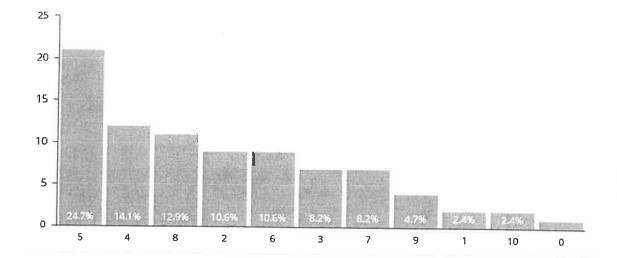
On a scale of 1 to 10, 2.4% indicated they would immediately recommend to others and answered an outright 10 on the scale. 24.7% indicate responded with a 5. Related comments included (but not limited to): “help if you had an employee succession plan”; pay is very behind the private sector”; “fine place to earn some money and experience, but there are better opportunities to be had elsewhere; “used to be the place to be. Now I don’t like to say I work for the city anymore”; “Council does not support staff and leads the community to not trust staff making for a stressful work environment”; “Council treats employees poorly”; “employees are personally made to suffer due to shortfalls in the city budget even though we are doing everything we can to make cuts and to do more with less”; “some of the stuff the Common Council and upper management does just baffles me. Seems like employees are just numbers to them”; “Common Council is a HUGE factor. Employees are never praised or recognized for what they do for the city. It’s always negative and demeaning, and seems they are ‘out to get’ the employees. There are ‘clicks’ on the Council which is obvious to everyone – except them.”
BRIEFLY SHARE WHAT YOU DISLIKE ABOUT WORKING FOR THE CITY
Responses include: “many departments are understaffed which can create tension.”; “we are understaffed. We are under paid. Pay increases have not kept up with inflation”; “a benefit for workers that live a healthy lifestyle in the insurance premiums.”
Other responses indicated: “the politics and having to walk on eggshells when dealing with a micromanaging Common Council. If only they would trust staff to carry out the direction of the Council without the constant second-guessing and ‘gotcha’ moments during public meetings”; “is incredibly difficult to hear the number of negative comments directed towards staff by Council members. Council should question staff and challenge staff to bring forward the best plan, budget, ideas, etc. However, staff shouldn’t have to be addressed in the condescending manner they are frequently addressed in by council members”; “I cannot stand how our common council is mismanaging money. Doesn’t care about its employees or citizens. Just their own agendas”; “watching the Common Council discuss raises and more specifically reference that public employees have it better than other jobs. Some council members behavior is truly unmotivating and disingenuous”; Council is not operating at the 24,000-mile level. They are micromanaging rather than let department heads run their departments”.
BRIEFLY SHARE WHAT MAKES THE CITY A GOOD OR BAD EMPLOYER
One the good side: “it is a good size, relatively safe community, the department heads and city administrator seem to have the best interest of the city and its’ employees in mind”; “the atmosphere and work environment on a day-to-day basis makes the city a good employer. Having great co-workers also enhances the experience. The Wisconsin Retirement System offered is top notch. I feel lucky to be employed by the city and cherish the opportunity”; “I trust my supervisor and working for this individual is a pleasure. Working with them is the one reason I have not left the position. I feel respected and valued by my supervisor”; “good people to work with”; “there are many talented and amazing people (employees) in the city.”
There are concerns expressed: “if I had a better opportunity, I would be doing it. I do think (city) lacks leadership in the right places to take it forward and keep it moving in the right direction”; “we are numbers $$$ not people”; employees are not able to give input”; “Council trash talking staff on record”; “Council talks a good game, but in the end will do whatever keeps them elected, which is at the expense of staff and in the long run, the residents”; “the Common Council makes the City a bad employer”; “management throughout the city wants what is best for their employees, however it is often shot down when it gets to the Council.”
I TRUST THE COMMON COUNCIL
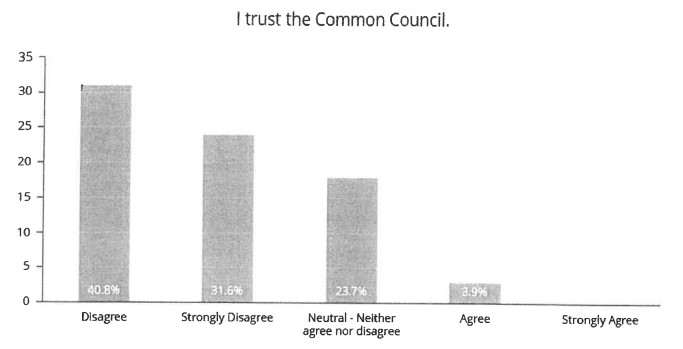
Only 3.9% of those responding agree with this statement! And 72.4% stated they either disagree or strongly disagree with this statement! Comments include: “it depends on the subject”; or “I have limited contact with the Common Council”; “I believe all members of the Council are trying to do good for the city. I think sometimes Council and employees spend too much time and effort reacting to problems that arise. If Council and employees trusted each other more and collaborated on the basis of running things well, then many of the problems would have been completely avoided in the first place”; “I commend the council for being public servants, truly thank you for your work. It is not easy”; “while I think they try and do their best; they may not understand what we do”; “there are a couple of decent people on the Council with morals and are actually there for the betterment of the city and its employees – and doing the right thing”; “It’s nice to see new members on the Council now and really ask questions. But it’s time to dig deeper”; “I appreciate the pressure and constraints the council is under”.
The deeper concern comes from comments like these: “the Common Council seems to be more interested in their own personal projects that they believe in (like concealed carry classes that nobody was interested in attending)”; “they do not seem to understand the ramifications of their words and actions to the budget and also to employee moral”; “the Council sees the employees as the enemy instead of the advisors’; “the Council does not understand their role and not to micromanage staff’s work”; “I believe they mismanage money and play politics with their decision making”; “there seems to be a general mistrust of, or lack of confidence in staff from the Council. Several members feel they need to micromanage and second-guess decisions made by staff. Please do your job to direct staff, but allow them to carry out your vision with a little flexibility”; “it is crystal clear that the council doesn’t value employee and do NOT have their interests in mind. They only care about the public or grandstanding. Hey… we are public people too. I live in Marshfield too.”; “some of the Common Council members have no idea what they are doing or saying and makes them seem incompetent”.
“I feel there are times that decisions are made prior to anyone walking into the council chambers. The topics on the agenda are to be discussed between Council people in a public forum, not behind closed doors”; “there are some strong personalities on the council that need to learn to reel it in a bit. They need to get off their high horse and quit micromanaging. I also feel Council members really need to be ‘in person’ rather than zoom meeting while they are living out of state. A new mandate should be created for alderpersons that they must attend in person so many meetings per month / year”.
Finally: “a lot of members have been on the Council for a long time. Everything gets approved or denied through them. One could say the current state of Marshfield is based directly off of how good or bad of a job the Council is doing”.
I TRUST THE CITY ADMINISTRATOR
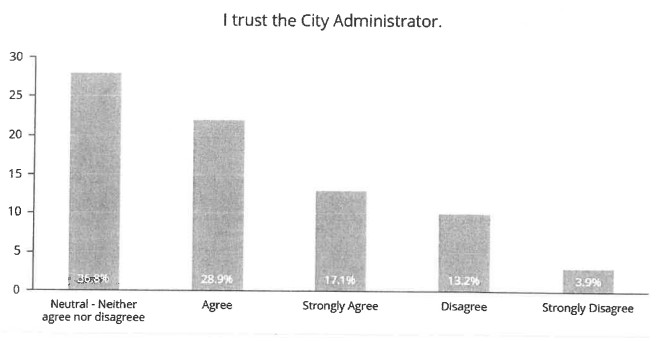
17.1% of respondents claim to either disagree or strongly disagree with this statement, leaving the remaining 82.9% agreeing or remaining neutral on the subject. Several comments centered around the fact that they have never had contact with the administrator. More replied: “The City Administrator is our leader. It’s a big role to fill and not easy. I think the characteristics needed for this position are someone who is strong minded with a sense of direction, not easily shaken, and willing to stand up for what needs to get done”; “I watch the administrator have to tread lightly with the Council. I would like the administrator to be able to be more firm with the Council, rather than shy away from voicing uncomfortable recommendations”; “I have seen him over the years get beat down by the council. Overall, I trust him more than the Council”; “is a man of integrity. He commits himself to the city of Marshfield and the staff. I have full confidence in him and his leadership skills”; “he does a good job overall”.
Yet, one comment included: (the administrator) “seems to side with the Common Council”.
Finally: “The administrator has a job that seems to bridge the gap so to speak. I think anyone in that position needs to understand what is at stake for everyone involved”.
I TRUST MY SUPERVISOR AND DIVISION/DEPARTMENT HEAD
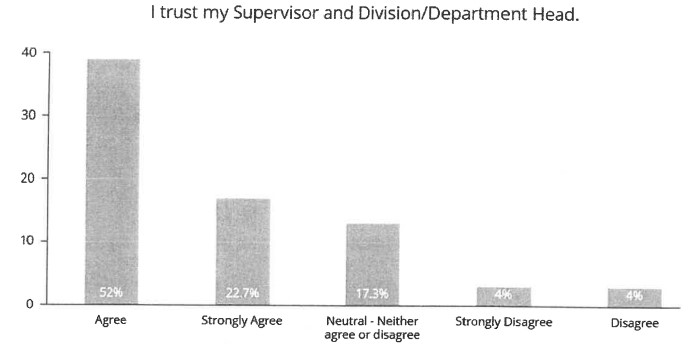
Overall, 74.4% taking part in the survey stated they either agreed or strongly agreed with this statement. 8% disagreed or strongly disagreed. Responses include: “They too have been beaten down by the games of the Council which is why we have open positions, which does not benefit anyone including the very people the council is supposed to represent”; “my department head works hard to keep our department working as a cohesive team. My opinions are valued and respected”; “I believe my department is run very well by caring individuals”.
DO YOU FEEL COMFORTABLE SPEAKING WITH COUNCIL MEMBERS?
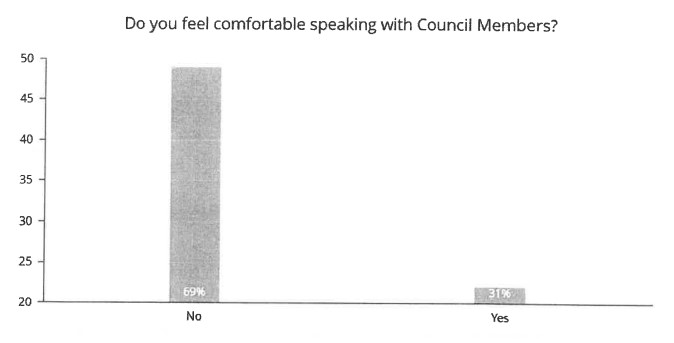
Several comments were submitted in relation to this question. 69% said “no”. That would leave the other 31% answering “yes”. Comments included: “I have no issue speaking up”; “if given the chance I would feel comfortable”; “a few (Council) seem to be looking for the “gotcha” moment, and to put you on the spot. There always seems to be an agenda, and some behind-the-scenes wrangling”; “if they were to come here, I would have a conversation with them and show them what we do and listen to their opinions”; or, ”I don’t cross paths with them often. So, it’s more of a speak when spoken to type of relationship”; “I don’t feel the Council wants to hear from staff”; “Neutral – “I have no problem with them in a professional manner, but don’t know them well enough to be ‘comfortable’ talking to them’; “depends on the member. I don’t trust most of them”; “they never come around to see how things are going or ask questions. I don’t mean the department heads, I mean with employes”; “have tried but it ends up being a disgruntle employee issue”.
Apparently frustrated, one respondent answered: “without an action plan and immediate follow through (beyond super low hanging fruit) I know nothing will change, and that I need to leave. I don’t fear losing my job, but I have no faith that anything will come of talking or this survey from the Council other than this survey, this survey is like the compensation plans, comprehensive plan, bike plans, etc. This will be shelved as ‘we did something’ but nothing happens”.
“There is a major lack of trust with the Council. They seem to have a lot of back-door meetings, discussions outside the council meetings; hidden agendas and a lot of collusion. It’s obvious they do not value staff input. As a result, there have been many departures at high level positions…mostly related to the conduct of the council. They did find other employment, and did say they left for better opportunity, but privately they left because of the council, compensation and benefits.”
BRIEFLY DESCRIBE WHAT YOU THINK COULD BE DONE TO IMPROVE THE RELATIONSHIP BETWEEN THE STAFF AND COMMON COUNCIL
Answers to this question varied, and several were a repeat of suggestions offered previously. But some include: “both need to be open-minded better communications with each other. Council needs to not blast employees publicly”; “meetings with Council and staff. There are none at this point. Be professional in a meeting”; “there needs to be a better understanding of the roles each of us has. Council. Administration. Staff. We all need to ‘stay in our lane’. There seems to be a general mistrust of staff from the Council. Several members feel the need to micromanage and second guess decisions made by staff. Please do your job to direct staff, but give them some breathing room to carry out your vision”; “trust staff. Let the City Administrator and other management do their job and give them the resources to do so without micromanaging everything. Council’s job should be to provide definitive clear direction of where the city should go and get out of the way. Make good on promises to staff about compensation”; “staff needs to know that the Council has respect for and trust in staff, we have been hired to do a job. Have confidence that we are doing that job. Come to us with concerns. Please know that we are not being deceitful and if we a have a common concern we are trying to bring it forward to you with the best intentions”.
They continue: “stop being aloof. Give direction when you want something done. Stop passing the buck when the hard decisions need to be made and stop thinking our benefit package is so wonderful”; “show they care for employees. Genuinely. They need to not micromanage things and trust the professionals that are already there (to) make sure the right job is done. Learn what is really going on and why things are the way they are done before ripping things apart”; “frankly, treat us with respect and think before you speak”; “I recognize it is the Council’s job to look out for (the) interest of the city, however they should put more emphasis on retaining talent which will allow us to be more efficient”; “it’s beyond repair”; “I don’t know if it can be fixed. I don’t think certain Council members like to be called out”.
Finally: “improving the relationship between staff and the Common Council requires fostering open communications, transparency, and mutual respect”; “give us a reason to trust you. Stop meeting behind the scenes and scheming and plotting – especially with felons, certain members of the media, etc. Quit acting like the ‘good ole boys club’ and think for yourselves- not what or how your buddies tell you to vote”.
COMMON COUNCIL PROVIDES STAFF WITH ENOUGH INFORMATION AND DIRECTION TO UNDERSTAND WHAT THE CITY’S PRIORITIES ARE
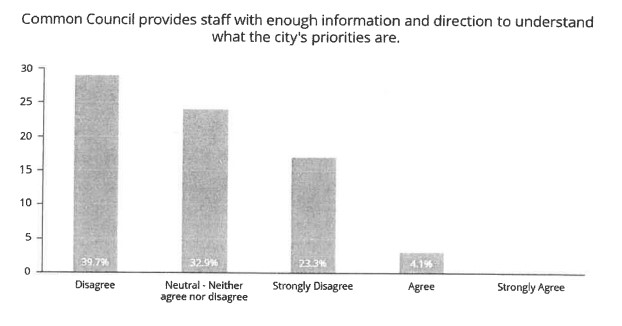
63% either disagreed or strongly disagreed with this statement, and only 4.1% agreed. The balance remained neutral in their answer. These numbers are supported with the following responses: “I don’t think the Council knows what the City’s priorities are”; “the Council gives no priorities. The mayor is not around and doesn’t do anything for staff”; “most meetings leave me with a feeling of ’what just happened, and what do we need to do now? Meetings should produce actionable recommendations”; “Council needs to give staff specific direction on services to cut if additional cuts are needed. Read materials before meetings and come prepared to ask questions so staff can understand what direction you want to go”; “the Council struggles with the overall direction of the city. Some Council members are more interested in getting friends on committees”; “Council needs to look not at ’their personal goals’ for the city, but overall public’s goal for the city. What is best for the entire city and just a select few”; “I don’t believe a lot of the Common Council truly understand the budget and how city government works”; “seems like members have had a hard time coming to a conclusion for a priority even among themselves”; “most Council members seem to have their own priorities, which aren’t usually priorities that benefit the city, staff and citizens”.
A most curious responded stated: “they all have their own hidden agendas. Recently at the Council meeting it was stated by an alderman that they like to ‘catch people off guard’. Is that ideal for staff to be prepared with the data they are asking for? Nobody likes to be blindsided. We want to provide accurate and researchable information, give us the opportunity to do so.”
DO YO FEEL ADEQUATELY INFORMED ABOUT THE CITY’S FINANCIAL POSITION BY STAFF AND/OR COMMON COUNCIL?
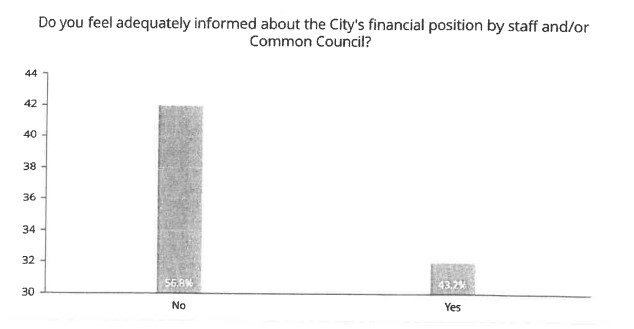
56% of respondents said “NO”; while 43% answered “YES”. Comments included: “Yes and no. Not very transparent. How did we get in this financial crisis? Where are we going and how do we get there?”; “most matter of budgets, financial standings, etc. are only discussed at Council meetings etc., but not really communicated to staff until maybe it’s too late”; “we’re always just told it’s terrible, and to prepare for the worst, and services and positions could be cut”; “I need better info so there is less misinformation being said”; “By staff…NOT by Council. Nor would I trust what Council says”. All that being said, there was one response that said: Yes, I understand the position the city is in.”
BRIEFLY DESCRIBE HOW THE CITY OF MARSHFIELD COULD IMPROVE EMPLOYEE COMMUNICATION FROM COUNCIL AND/OR DIVISION/DEPARTMENT HEADS
The responses to this question brought many of the same comments in the same spirit of much that has already been stated previously. They include: “communicate as much as possible. I think the communication is good”; “the Department Heads need to be able to take employee input to the members of the Council)”; “come talk face to face”; “include more staff and not just department heads in meetings”; “be more present physically in person to see what we actually do on a daily basis”; “more frequent staff updates”; “staff meetings”; “we need to be stressing a TEAM environment, across all departments”; “be realistic. Nobody knows how everything works. Keep emotions in check during meetings, very hard to do with different personalities all trying to be boss”; “I feel current employees do not feel they can be blunt/honest with the current City Council”; “encourage two-way communications. Promote an environment where the employees feel comfortable expressing their thoughts, concerns, and ideas. Recognize and celebrate achievements”; “more openness and willing to listen and follow through”; “many of the Council members seem to have no interest in communicating with most or all departments”.
“No one will likely say it but there have been numerous comments made that the unprecedented loss of department heads in the recent few years has partially been due to the way they were treated by Council”.
A positive tone comes through: “my department head efficiently communicates with me”; “my division head already does a good job with communication”; “the employees should appreciate the Council position and their challenges”.
One suggestion said: “monthly newsletters”; only to be followed by another stating: “NOT newsletters”.
Concerns relating to the survey itself: “Council should start by listening to employees, but after this survey, I’m sure this will drive a bigger wedge between them”; “I have no faith that anything will come of this survey in a timely manner, if at all”; “I am tired of watching study after study being done to find solutions only to watch the lack of desire to follow recommendations that come from these studies. Several of these studies have been a waste of time and money. Several salary and staff needs studies that were commissioned only to decide we can’t afford to follow the plans that come from these studies. It’s been very frustrating to watch.”
And, in conclusion: “I think most of the staff had the best interest of the city in mind during their day-to-day duties, and I think most of the Council does, too. However, the working relationship between Council and staff needs some improvement. Change is hard, and I think it will take a long time to repair the relationships. I’m just not sure what the first step is”.
SO. WHAT IS THE FIRST STEP?